Degradation behaviour of the artificial sweetener Acesulfame-K within a riverbank filtration system
Mursaikova, Kuráž and co-authors · Journal of Water Process Engineering 63, 105453
Open-source scientific modelling
DRUtES is a finite-element platform for flow and transport processes in porous media and catchments. Built for researchers and environmental modellers who need to connect physical understanding with reproducible simulations.
Developed by Michal Kuraz, Johanna Ruth Thomson and Petr Mayer.
From physical processes to decision support.
1D · 2D · 3D
Spatial modelling
Finite elements
Process-based formulations
Modern Fortran
Open scientific code
GPL v3
Open-source licence
Preserving open science. DRUtES is part of the GitHub Arctic Code Vault — preserving open-source code for future generations.
Vadose zone and groundwater applications
Investigate how water, energy and dissolved substances move through soils and aquifers. Select the physical model, constitutive relations and boundary conditions appropriate to your question.
01 / WATER
Richards-equation flow in variably saturated media, groundwater flow, dual-permeability formulations, and applications involving root water uptake and evaporation.
02 / ENERGY
Heat transport and coupled water–heat processes, including soil freezing. Numerical treatment matters where nonlinear behaviour and phase change make a calculation demanding.
03 / TRANSPORT
Advection, dispersion and reaction in porous media, with conservative transport, sorption and kinetic processes for environmental transport questions.
Hydrological catchment applications
DRUtES also supports catchment-scale applications, connecting terrain-based modelling and transport equations with hydrological information.
TERRAIN-BASED MODELLING
Erosion modelling using a kinematic-wave formulation on real catchment topography, connecting overland-flow pathways with the terrain of the study area.
RHINE & DANUBE BASINS
Advection–dispersion–reaction modelling on large catchments, tested currently for Rhine basin. Integration with the mHM framework provides the hydrological modelling component for the DRUtES transport applications.
Hydrological framework: mHM — the mesoscale Hydrological Model
DRUtES Online
A browser interface for preparing models, running simulations and inspecting results. Guided workflows connect the numerical platform with practical research tasks.
Currently supported online: 1D problems only — Richards equation and heat transport. The online interface does not provide the full range of models and dimensions available in the DRUtES numerical platform.
Research in practice
Selected studies connect model development with water quality, preferential flow and coupled processes. Explore the physical questions, modelling approaches and published research behind the platform.
WATER QUALITY / 2024
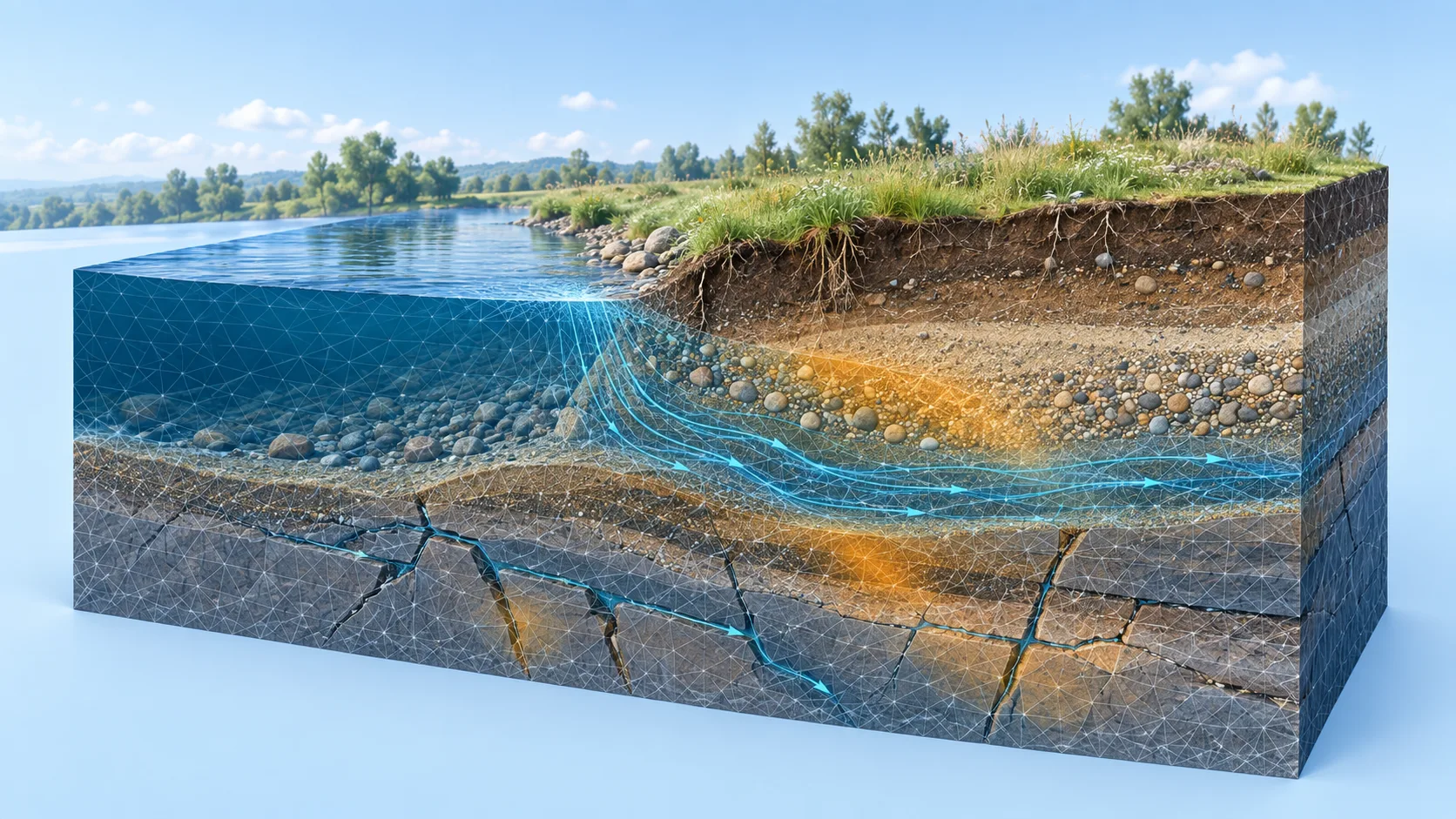
Modelling the attenuation of Acesulfame-K in the Káraný riverbank-filtration system. Coupled groundwater-flow and transport calculations help interpret monitoring observations.
PREFERENTIAL FLOW / 2013
Dual-permeability flow and contaminant transport at the Richard repository. Infiltration scenarios examine how an engineered barrier responds as conditions change.
COUPLED PROCESSES / 2024
A regularisation strategy for coupled water and heat flow. The study addresses numerical oscillations and the balance between stability and physical interpretation.
Mursaikova, Kuráž and co-authors · Journal of Water Process Engineering 63, 105453
Thomson & Kuráž · Computers & Fluids 277, 106299
Kuráž, Jačka, Blöcher & Lepš · Advances in Engineering Software 173, 103278
Kuráž & Mayer · Acta Polytechnica 53(4)
Šolín & Kuráž · Advances in Water Resources 34, 1062–1081
Research collaborations
European collaborations connect basin-scale hydrology, climate information and process-based models with water-resource assessment, ecosystem restoration and practical applications.
HORIZON EUROPE / 2023–2026
Danube Region Water Lighthouse Action.
Modelling contribution
Hydrological modelling and validation, connecting basin-scale information with process-based assessment.
Grant 101094070 · funded project
HORIZON EUROPE / 2025–2029
Water, migratory fish and habitat restoration in the Danube basin and northwestern Black Sea.
Modelling contribution
Modelling and platform work that integrates hydrological information and pilot data. Ongoing project.
Grant 101215230 · funded project
HORIZON EUROPE / EUSPA / 2025–2026
Copernicus and EGNSS services for users in Chile and Colombia.
Modelling contribution
Process-based hydrology and climate-information workflows associated with water-management applications.
Grant 101131859 · funded project
INTERREG CENTRAL EUROPE / 2019–2022
Board for Detection and Assessment of Pharmaceutical Drug Residues in Drinking Water — Capacity Building for Water Management in Central Europe.
The collaboration combined monitoring, hydrological investigations and modelling to understand emerging contaminants and support water-management decisions.
TAČR / 2024–2026
Updating runoff Curve Numbers for flood and drought prevention in the Czech Republic.
The project refines rainfall–runoff assessment through updated crop and management information, hydrological soil groups and quantification of shallow subsurface runoff.
SS07020469 · Environment for Life programme
April 2024–June 2026
Main author
Hydrological & groundwater modeller
Founder and primary developer of DRUtES
My work connects hydrology and hydrogeology with numerical methods and scientific software development. I develop and apply models of water flow, heat and contaminant transport to support environmental research and practical assessment.
I contribute from the conceptual model and governing equations through implementation, calibration and interpretation. DRUtES is one part of this wider modelling and research practice.
Johanna Ruth Thomson
Evaporation, freezing and coupled-process modelling.
Petr Mayer
Linear algebra, matrix structures and solvers.

Work together
Let’s discuss a hydrological or groundwater modelling assignment, a coupled-process study, or a collaboration on scientific software and reproducible workflows.
DRUtES · GitHub repository · GPL v3 · Privacy Policy
Physical understanding. Reproducible modelling.